
The Fertility Diet: What to Eat When Trying to Conceive
 By
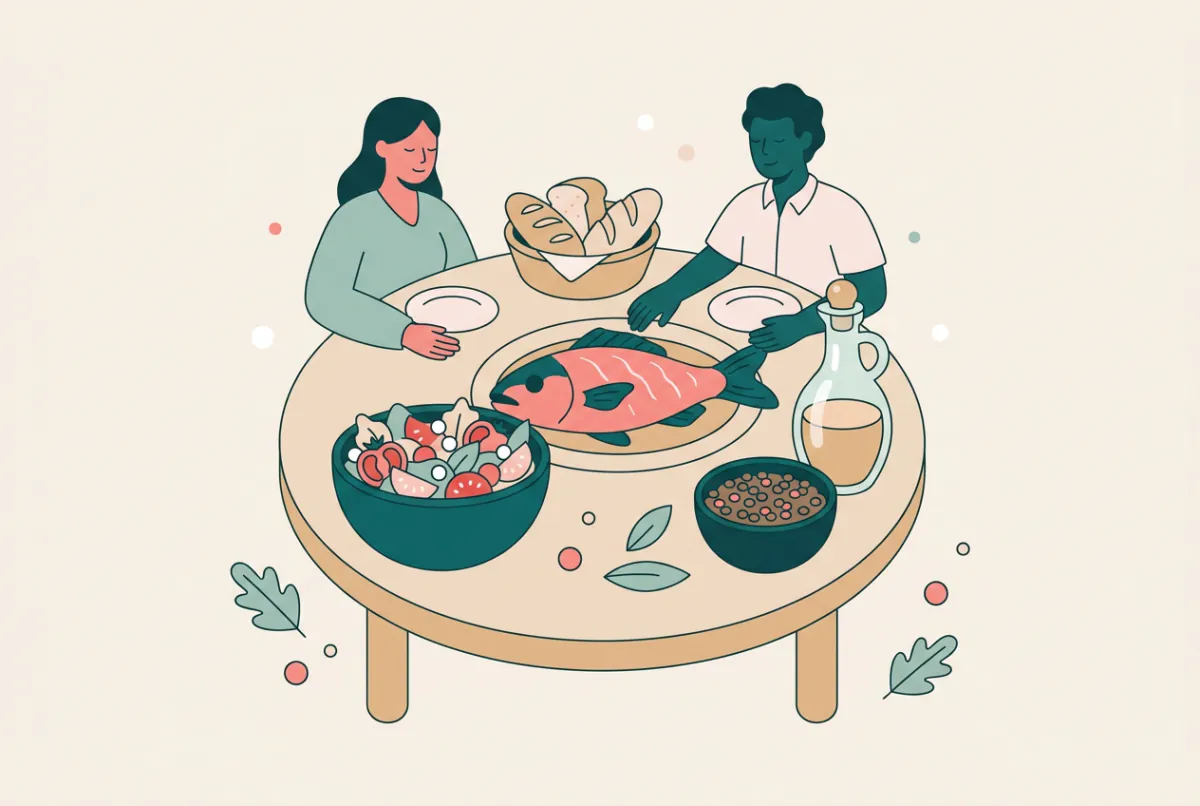
Fertility diet advice is everywhere. The research behind it is more modest. One large Harvard study defined a pattern linked to less ovulation-related infertility, and a handful of studies have looked at Mediterranean-style eating and IVF. None of it is from randomized trials. Here is what is solid, what is not, and what experts actually recommend.
Is there a diet that improves fertility?
Not one that has been proven. ASRM’s 2022 committee opinion concludes there is insufficient evidence that a specific diet or intake of particular nutrients can improve natural fertility, and that robust evidence is lacking that diet and lifestyle changes improve fertility, though they are worth making for general health.2 It notes fertility rates are lower in women who are very thin or obese.2 The one dietary step every guideline agrees on is folic acid: 400 mcg a day, starting at least a month before conception.9
The Nurses’ Health Study II “fertility diet”
The best-known fertility diet comes from the Nurses’ Health Study II. Researchers followed 17,544 women without a history of infertility for eight years as they tried to become pregnant, and scored their diets on factors previously linked to lower ovulatory infertility.1 A higher score meant:
- more monounsaturated fats (such as olive oil) instead of trans fats,
- more vegetable protein than animal protein,
- low-glycemic carbohydrates,
- high-fat dairy rather than low-fat,
- a multivitamin,
- iron from plants and supplements.1
Women with the highest scores had a 66% lower risk of infertility caused by ovulation disorders than those with the lowest (relative risk 0.34).1 Combining five or more low-risk factors, including diet, weight control and physical activity, was linked to a 69% lower risk.1
Two cautions matter. First, this is an observational study: healthier eaters may differ in other ways. Second, it applies to infertility caused by ovulation problems, not to every fertility problem. When the same score was tested in women having IVF, it was not associated with pregnancy or live birth rates, according to ASRM.2
The Mediterranean diet
Mediterranean-style eating, rich in vegetables, fruit, olive oil, fish and poultry, has mixed evidence. In a Greek cohort of 244 non-obese women having their first IVF cycle, those least adherent to the Mediterranean diet had lower clinical pregnancy (29.1% vs 50.0%) and live birth rates (26.6% vs 48.8%) than the most adherent.4 The association held only for women under 35.4
ASRM notes that some studies link Mediterranean and similar diets to better IVF outcomes, while other cohort studies found no association, and that randomized trials are needed.2
What a 2018 review of diet and fertility found
A Harvard review of the field identified a few consistent patterns:3
- Supplemental folic acid has been consistently linked to less infertility, lower pregnancy loss and better infertility treatment results.
- Long-chain omega-3 fats appear to improve female fertility; see DHA for fertility.
- Healthy diets favoring seafood, poultry, whole grains, fruits and vegetables are linked to better fertility in women and better semen quality in men.
- Dairy and soy, once suspected, have not been consistently tied to poor fertility.
- Vitamin D does not appear to play an important role without deficiency.
Fertility diet: the evidence at a glance
| Claim | What the studies show | Evidence grade |
|---|---|---|
| A “fertility diet” lowers ovulatory infertility | RR 0.34 in 17,544 women, observational1 | Low |
| Mediterranean diet improves IVF success | Better in one cohort under 35; no link in others24 | Low |
| Any diet improves natural fertility in ovulatory women | Little evidence, per ASRM2 | Insufficient |
| Folic acid prevents neural tube defects | Basis of CDC recommendation9 | High |
Caffeine
You do not need to give up coffee. ASRM says moderate caffeine, about one to two cups of coffee a day, has no apparent adverse effects on fertility or pregnancy outcomes, while high intake (500 mg, or more than five cups a day) has been associated with lower fertility.2 Caffeine has no effect on semen parameters.2 During pregnancy, ACOG considers under 200 mg a day moderate and not a major factor in miscarriage or preterm birth.7
Alcohol
The evidence for light drinking is reassuring, but the advice is still to keep it low. In a Danish cohort of 6,120 women trying to conceive, fewer than 14 servings a week had no discernible effect on fertility.5 ASRM recommends limiting alcohol to minimal or moderate use while trying, and stopping altogether once you are pregnant, because no safe level has been established.2
For partners, a meta-analysis of 15 studies with 16,395 men linked alcohol to lower semen volume and normal morphology, mostly in daily drinkers; occasional, moderate drinking did not appear to harm semen.8
Fish and mercury
Fish is worth eating, carefully. FDA and EPA advise 2 to 3 servings a week from their Best Choices list if you are or may become pregnant, and avoiding king mackerel, marlin, orange roughy, shark, swordfish, Gulf of Mexico tilefish and bigeye tuna.6 ASRM notes high blood mercury from heavy seafood consumption has been associated with infertility.2
A practical fertility diet
Put together, a sensible plan looks like this:
- Take a prenatal with folic acid; prenatal nutrient doses shows what to look for on the label.
- Build meals on vegetables, fruit, whole grains, legumes, nuts and olive oil.
- Choose plant proteins and low-mercury fish often, and swap trans fats for monounsaturated fats.
- Keep caffeine to about 1 to 2 cups of coffee a day, and alcohol low.
- Get enough choline, which most prenatals lack: see choline before pregnancy.
This is good advice for health in general, which is the strongest reason to follow it. For everything else before you start, use our preconception checklist and the Prepare hub.
Frequently asked questions
This page is educational and is not medical advice. Talk to a clinician about your own situation, and seek urgent care for heavy bleeding, severe pain or fainting.
Keep reading

The Preconception Checklist: What to Do Before You Try
A preconception checklist built on CDC, ACOG and ASRM guidance: folic acid, a prepregnancy visit, vaccines, medicines, alcohol, caffeine and partner health.
DHA for Fertility: Does Omega-3 Help You Conceive?
DHA and omega-3 for fertility: what studies show for conception, the 200 mg pregnancy target, fish and mercury advice, preterm birth data and evidence grades.

Choline Before Pregnancy: The Nutrient Most Prenatals Miss
Choline before pregnancy: the 450 mg adequate intake, why most prenatals contain little or none, egg and food sources, brain-development evidence and safety.
Pregnancy Nutrition: What to Eat, What to Avoid and Why
What to eat in pregnancy and what to avoid, from ACOG, FDA and CDC: key nutrients, the fish and mercury chart, listeria foods, the 200 mg caffeine limit and alcohol.

Step 1: Prepare for pregnancy
How to prepare for pregnancy: when to start a prenatal and folic acid, what a preconception checkup covers, and what the evidence says about supplements.
Sources
- 1Diet and lifestyle in the prevention of ovulatory disorder infertility. Obstetrics & Gynecology. Chavarro JE et al., 2007. Nurses’ Health Study II, 17,544 women followed 8 years
- 2Optimizing natural fertility: a committee opinion. American Society for Reproductive Medicine. ASRM and SREI Practice Committees, Fertil Steril 2022;117:53–63
- 3Diet and fertility: a review. American Journal of Obstetrics & Gynecology. Gaskins AJ, Chavarro JE, 2018
- 4Adherence to the Mediterranean diet and IVF success rate among non-obese women attempting fertility. Human Reproduction. Karayiannis D et al., 2018. 244 women, Athens
- 5Alcohol consumption and fecundability: prospective Danish cohort study. BMJ. Mikkelsen EM et al., 2016. 6,120 women aged 21–45
- 6Advice about eating fish. U.S. Food and Drug Administration and EPA. 2–3 servings a week from Best Choices; highest-mercury fish to avoid
- 7ACOG Committee Opinion No. 462: Moderate caffeine consumption during pregnancy. Obstetrics & Gynecology. American College of Obstetricians and Gynecologists, 2010
- 8Semen quality and alcohol intake: a systematic review and meta-analysis. Reproductive BioMedicine Online. Ricci E et al., 2017. 15 studies, 16,395 men
- 9About folic acid. Centers for Disease Control and Prevention. 400 mcg daily, at least 1 month before conception