
Does Ovulation Cause Cramps?
A twinge or ache in the middle of your cycle is common. Here is what it means for timing, and what it can be confused with.
 By
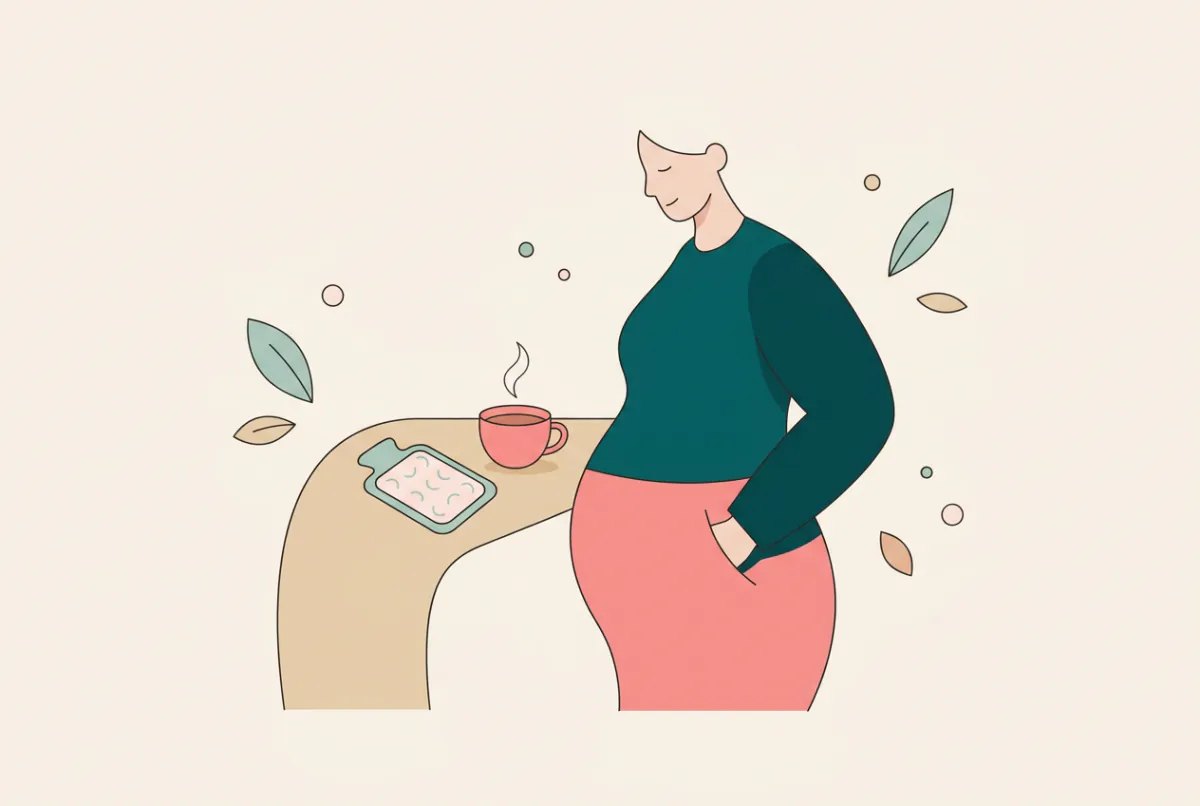
A dull ache or a sharp twinge low on one side, right in the middle of your cycle, is one of the more common things people notice while trying to conceive. It has a name, mittelschmerz, German for "middle pain." It is usually harmless and can even help you sense when your fertile window is at its peak. Here is what causes it, how long it lasts, and when cramping is a sign of something else.
Does ovulation cause cramps?
Yes, for many people. Mittelschmerz is one-sided lower abdominal pain that happens at or around ovulation.1 MedlinePlus states that about one in five women have pain around the time of ovulation.1 A clinical review estimates it may affect over 40% of women of reproductive age, often almost every month.2 Cleveland Clinic gives a similar upper figure of up to 40%.3 The spread in estimates mostly reflects how mild a twinge has to be before someone counts it.
What does ovulation pain feel like?
It is usually felt on one side of the lower abdomen or pelvis, and is described as anything from a mild ache to sharp, cramping pain.13 Severe pain is rare.1 The side can switch from month to month or stay the same for several months.1 Cleveland Clinic lists other symptoms that can come with it: light spotting, clear and stretchy discharge, nausea when the pain is strong, and low back pain.3
How long do ovulation cramps last?
Ovulation pain usually lasts minutes to a few hours, and sometimes up to 24 to 48 hours.13 It begins roughly midway through the cycle.1 Pain that runs well beyond two days, or keeps getting worse, is not typical mittelschmerz.
What causes ovulation pain?
The exact cause is not settled, and there are a few explanations. Before ovulation, the growing follicle stretches the surface of the ovary.1 When the follicle releases the egg, a little fluid or blood can escape and irritate the lining of the abdomen.1 Ultrasound supports this: in a 1979 study, small amounts of free fluid were seen at mid-cycle in 40% of cycles, and two thirds of the cycles with pain showed fluid at ovulation.4
A newer view, summarized in a clinical review, is that the rise in luteinizing hormone (LH) itself increases contractions of smooth muscle around the follicle through prostaglandins, which may produce pain before the follicle ruptures.2
Is ovulation pain a reliable sign you are ovulating?
It is a useful clue, but not a precise timer. The clinical review notes that mittelschmerz tends to coincide with the peak in blood LH, while the follicle is still enlarging and has not ruptured.2 In the WHO study that timed ovulation at surgery, ovulation followed the LH peak by a median of 16.5 hours.5 So pain may arrive up to a day before the egg is released, which still falls in the most fertile part of the window.
Two cautions. Not everyone feels it, and it does not happen every cycle for everyone. And Cleveland Clinic notes that ovulation pain does not affect fertility: having it does not make you more fertile than someone who does not.3 If you want to time sex precisely, pair it with LH tests, and see our full list of signs of ovulation.
When to have sex if you feel ovulation pain
If you are trying to conceive, mid-cycle pain is a good prompt to have sex that day and the next, if you have not already. The best odds come from sex in the two days before ovulation, and ASRM recommends sex every one to two days through the whole six-day window rather than waiting for one signal.7 Our fertile window guide explains how to find all six days.
How is ovulation pain diagnosed?
Usually from the pattern alone: one-sided pain in the middle of the cycle that settles within a day or two. A pelvic exam is normal in mittelschmerz.1 If the pain keeps coming back or is unusually strong, a clinician may order an ultrasound to rule out other causes, and the scan can sometimes show a collapsed follicle that supports the diagnosis.1
A simple log helps whoever examines you. For two or three cycles, note the day the pain starts, which side, how long it lasts, and the day of your first positive LH test if you use them. Pain that reliably sits beside your LH surge points to ovulation; pain that drifts to other parts of the cycle points elsewhere.
How to ease ovulation cramps
Most of the time no treatment is needed.1 Rest and over-the-counter pain relievers usually help.3 If the pain is intense or long-lasting, a clinician can rule out other causes.1
What else can cause mid-cycle pelvic pain?
Pain that feels like ovulation can come from other conditions. Cleveland Clinic lists endometriosis, adhesions from surgery, sexually transmitted infections such as chlamydia, pelvic inflammatory disease, ovarian cysts, ovarian torsion, ectopic pregnancy, appendicitis and inflammatory bowel disease.3 Painful periods and painful sex alongside mid-cycle pain can point toward endometriosis.
Call your clinician if you have mid-cycle pain with a fever above 100.4°F, pain when urinating, severe nausea or vomiting, pain that is not relieved by over-the-counter medicine, heavy bleeding between periods, or severe pain that lasts more than a day or returns most months.3 Contact a clinician too if your usual ovulation pain changes or comes with vaginal bleeding.1
If your period is late or a pregnancy test is positive, one-sided pelvic pain or abnormal bleeding should be reported the same day, because it can be an ectopic pregnancy. Sudden severe pain in the abdomen or pelvis, shoulder pain, weakness, dizziness or fainting can mean internal bleeding: go to an emergency room or call 911.6
Cramps later in the cycle
Cramping a week or more after ovulation is not mittelschmerz. If you are counting days, the DPO calculator tells you how far past ovulation you are and when a pregnancy test can give a reliable answer.
For more on finding and using your fertile days, browse the Try hub.
Frequently asked questions
This page is educational and is not medical advice. Talk to a clinician about your own situation, and seek urgent care for heavy bleeding, severe pain or fainting.
Keep reading
Signs of Ovulation: What Your Body Shows, and How Reliable It Is
The signs of ovulation, from egg-white mucus and an LH surge to a temperature rise and mid-cycle pain, with how well each one pinpoints the day.
Your Fertile Window: Which Days You Can Get Pregnant
Your fertile window is the 6 days ending on ovulation. See how many days after your period you ovulate, why it shifts, and how to track it.
Endometriosis and Fertility: What Helps You Get Pregnant
Endometriosis affects about 10% of women and up to half of those with infertility. How it affects fertility, what ESHRE recommends, and when to see a specialist.
DPO Calculator
Free DPO calculator: find how many days past ovulation you are, when implantation usually happens, and the earliest and most reliable days to take a pregnancy test.
Sources
- 1Mittelschmerz. MedlinePlus (U.S. National Library of Medicine). Medical encyclopedia entry, reviewed May 2025
- 2Mittelschmerz (StatPearls). NCBI Bookshelf. Brott NR, Le JK. StatPearls Publishing
- 3Ovulation Pain (Mittelschmerz): Causes and Treatment. Cleveland Clinic. Patient education page
- 4Mittelschmerz. Sonographic demonstration. JAMA. Hann LE, Hall DA, Black EB, Ferrucci JT, 1979
- 5Temporal relationships between ovulation and defined changes in the concentration of plasma estradiol-17 beta, luteinizing hormone, follicle-stimulating hormone, and progesterone. I. Probit analysis. American Journal of Obstetrics and Gynecology. World Health Organization Task Force, 1980
- 6Ectopic Pregnancy (FAQ155). American College of Obstetricians and Gynecologists. Patient FAQ, last reviewed April 2026
- 7Optimizing natural fertility: a committee opinion. American Society for Reproductive Medicine. ASRM and SREI Practice Committees. Fertil Steril 2022;117:53–63