
Can You Only Get Pregnant During Ovulation?
Pregnancy needs an egg, but the sperm can arrive days early. Here is what that means for every part of your cycle.
 By
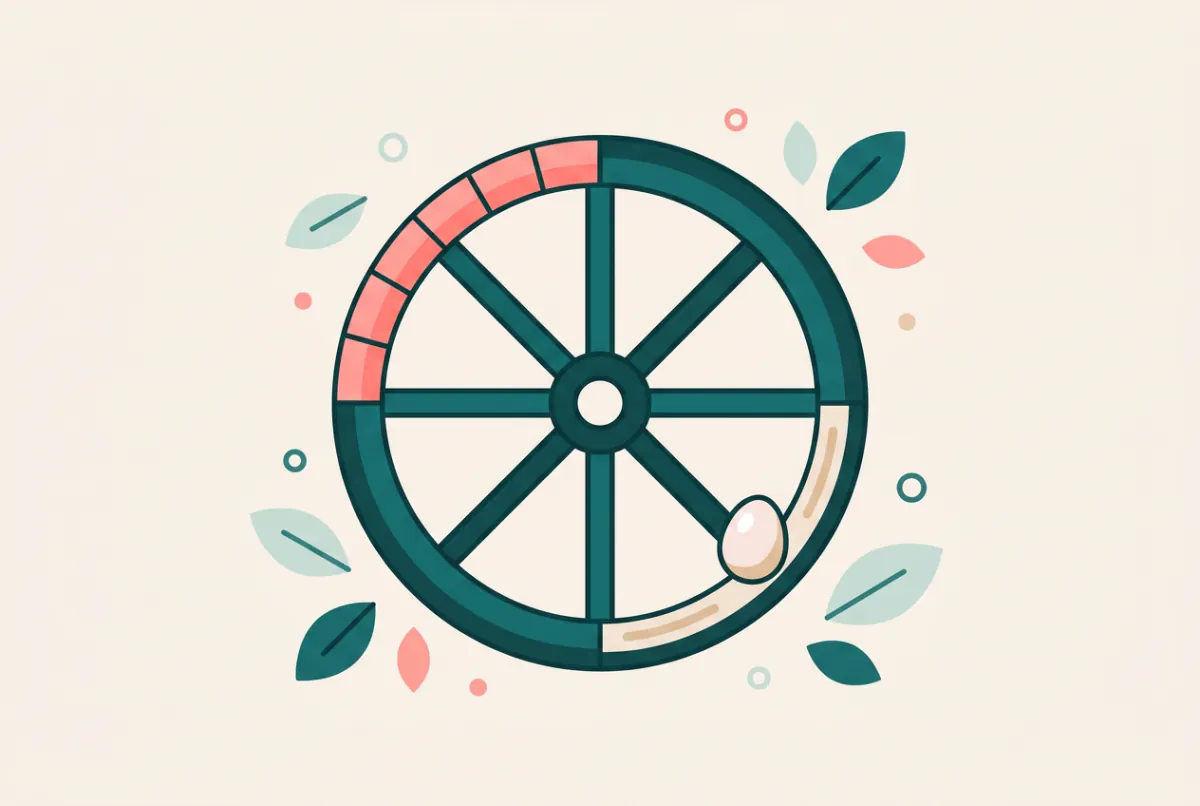
It is a fair question, because ovulation lasts only a moment and the egg lives about a day. But conception does not need sex to happen at that moment. Sperm can arrive days ahead and wait. That is why your chance of pregnancy is spread over a short window, and why some days that feel safe are not.
Can you only get pregnant during ovulation?
No. You can get pregnant from sex on any of the six days that end on ovulation day: the five days before the egg is released and the day itself.1 The egg has to be there for fertilization, but it does not have to be there when you have sex. Sperm can survive for several days, while the egg survives about 12 to 24 hours after ovulation.2
In the study that defined this window, 221 women trying to conceive collected daily urine samples for 625 cycles. All 192 pregnancies came from sex within that six-day stretch. Not one came from sex after ovulation day.1
How the odds change across the window
The chance of pregnancy builds through the window and peaks just before ovulation. In the 1995 study, a single day of sex five days before ovulation led to conception about 10% of the time, rising to about 33% for sex on ovulation day.1 When researchers later corrected for errors in pinpointing ovulation, the highest odds fell on the day before ovulation, and the odds fell close to zero after it.3
Looking at the calendar instead of the ovulation day gives a similar picture. Among women who described their cycles as generally regular, ASRM reports that the chance of clinical pregnancy from one act of intercourse rose from 3.2% on cycle day 8 to 9.4% on day 12, then fell below 2% by day 21.4 The odds by calendar day are lower than the odds by ovulation day because ovulation does not fall on the same calendar day for everyone.
Can you get pregnant right before or after ovulation?
Before ovulation, yes: the two days before are the most fertile of the cycle.13 After ovulation, it becomes very unlikely within a day, because the egg is no longer viable.2 The practical risk is not the biology but the guesswork. If you think you ovulated on day 14 but actually ovulated on day 17, sex on day 16 is not after ovulation at all.
Can you get pregnant on or near your period?
Yes, it can happen, mainly when cycles are short or ovulation comes early. In a study tracking 696 cycles with urine hormones, an estimated 2% of women were already in their fertile window by cycle day 4, and 17% by day 7.5 About one third of the women with short cycles had reached their fertile window by the end of the first week.5 Because sperm can survive for several days, sex late in a period or just after it can meet an early egg.
At the other end of the cycle, women with regular cycles still had a 1% to 6% chance of being in their fertile window on the day their next period was due.5 Late ovulation explains that too.
Why safe days are hard to predict
Ovulation moves more than most people expect. In an analysis of 612,613 cycles, the first half of the cycle (before ovulation) ranged from about 10 to 30 days, and that range drove most of the difference between short and long cycles.8 In the BMJ study, only about 30% of women had their fertile window entirely within cycle days 10 to 17.5 The authors concluded that the timing of the fertile window can be highly unpredictable, even when cycles are usually regular.5
Your body offers a better guide than the calendar. In a study of 193 women using a mucus-based method, the chance of conception was close to zero on days with no noticeable vaginal secretions and close to 30% on days with the most fertile-type mucus.6 Learn the pattern in our cervical mucus guide and our list of signs of ovulation.
What this means if you are trying to conceive
Aim to have sex every one to two days through the whole window rather than waiting for a perfect day. ASRM says that frequency gives the highest pregnancy rates, and that sex two to three times a week throughout the cycle gives nearly the same results.4 To know when the window opens:
- Start with an estimate from the ovulation calculator.
- Confirm the timing with LH tests, or with a monitor that reads more than one hormone.
- Read our guide to the best time to have sex to conceive for a simple schedule.
What this means if you are trying not to get pregnant
Using the calendar to avoid pregnancy is less reliable than many people assume. ACOG reports that with typical use, 12 to 24 out of 100 people relying on fertility awareness methods become pregnant in the first year.7 Natural Cycles is FDA-cleared as a contraceptive app and also offers a plan-pregnancy mode. If preventing pregnancy is important to you, a clinician can help you compare options.
The bottom line
Pregnancy depends on ovulation, but not only on sex at the moment of ovulation. Think of it as a six-day window that ends when the egg is released, with the best odds just before. For the full picture of how to find yours, start with our fertile window guide, or browse everything in the Try hub.
Frequently asked questions
This page is educational and is not medical advice. Talk to a clinician about your own situation, and seek urgent care for heavy bleeding, severe pain or fainting.
Keep reading
Your Fertile Window: Which Days You Can Get Pregnant
Your fertile window is the 6 days ending on ovulation. See how many days after your period you ovulate, why it shifts, and how to track it.

The Best Time to Have Sex to Conceive
The best time to have sex to get pregnant is the 2 days before ovulation. How often to have sex, whether position or lying down matters, and a simple plan.
Ovulation Calculator
Free ovulation calculator: estimate your ovulation day and fertile window for the next 3 cycles, with a day-by-day table for 21 to 35-day and irregular cycles.

Signs of Ovulation: What Your Body Shows, and How Reliable It Is
The signs of ovulation, from egg-white mucus and an LH surge to a temperature rise and mid-cycle pain, with how well each one pinpoints the day.
Sources
- 1Timing of sexual intercourse in relation to ovulation. Effects on the probability of conception, survival of the pregnancy, and sex of the baby. New England Journal of Medicine. Wilcox AJ, Weinberg CR, Baird DD, 1995. 221 women, 625 cycles, 192 pregnancies
- 2Ovulation: Calculating, Process, Pain and Other Symptoms. Cleveland Clinic. Patient education page, used for egg and sperm lifespan
- 3Day-specific probabilities of clinical pregnancy based on two studies with imperfect measures of ovulation. Human Reproduction. Dunson DB, Baird DD, Wilcox AJ, Weinberg CR, 1999
- 4Optimizing natural fertility: a committee opinion. American Society for Reproductive Medicine. ASRM and SREI Practice Committees. Fertil Steril 2022;117:53–63
- 5The timing of the "fertile window" in the menstrual cycle: day specific estimates from a prospective study. BMJ. Wilcox AJ, Dunson D, Baird DD, 2000. 221 women, 696 cycles
- 6Cervical mucus secretions on the day of intercourse: an accurate marker of highly fertile days. European Journal of Obstetrics, Gynecology and Reproductive Biology. Scarpa B, Dunson DB, Colombo B, 2006. 193 women, 2,755 cycles
- 7Fertility Awareness-Based Methods of Family Planning (FAQ024). American College of Obstetricians and Gynecologists. Patient FAQ, last reviewed February 2025
- 8Real-world menstrual cycle characteristics of more than 600,000 menstrual cycles. npj Digital Medicine. Bull JR et al., 2019. 612,613 ovulatory cycles